Automated Fiber-Cut, Failover & Optical Link Testing
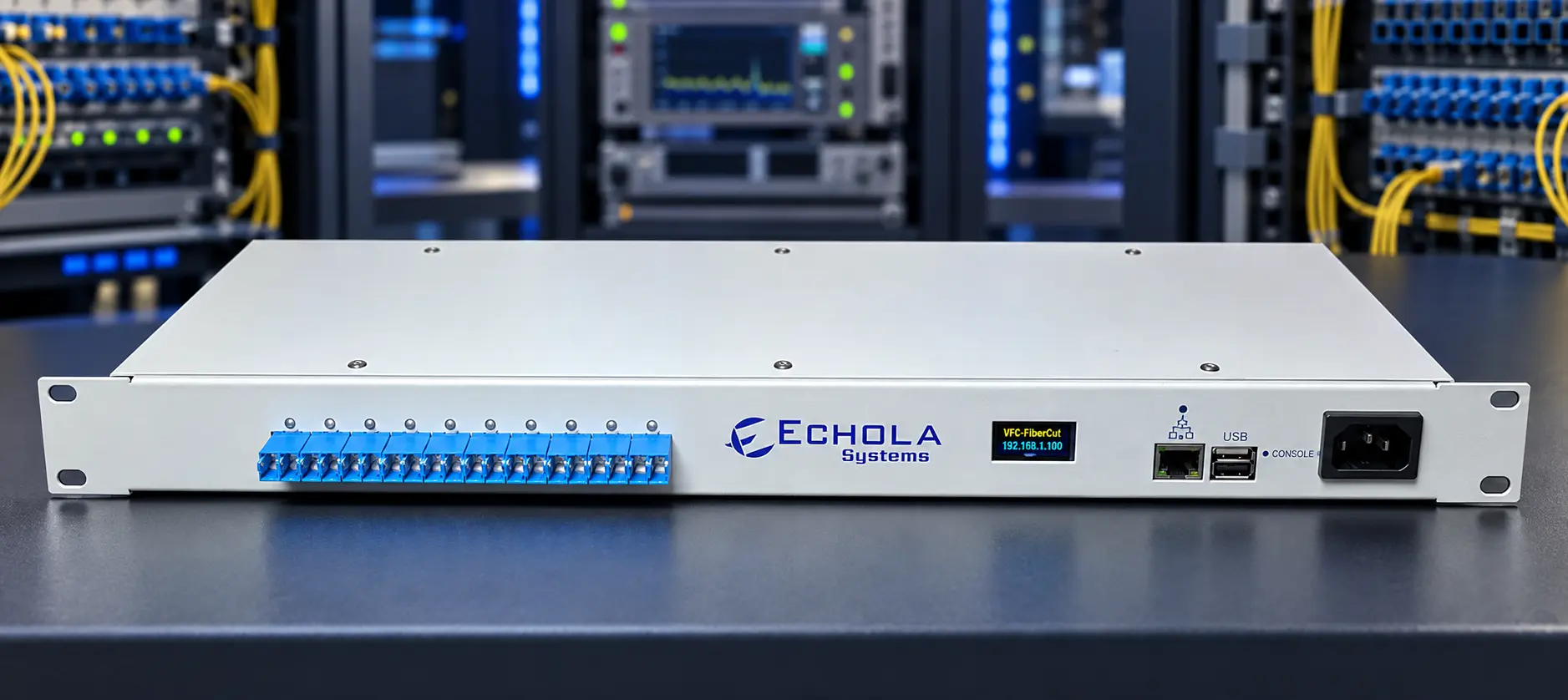
Echola Systems' Fiber-Cut Switches are designed to simulate real-world fiber cuts, enabling seamless failover testing and automation in QA and R&D test labs. By automating fiber-cut failure detection, these switches help identify faults early, reducing costs associated with customer-reported issues and the impact of fixing them later. The FC series switches use 1x1 MEMS switches to simulate clean fiber cuts, while the VFC series switches utilize MEMS VOAs to replicate real-world fiber-cut scenarios. Both single-mode and multi-mode options are available. The VFC series also supports optical transceiver and link validation through programmable attenuation sweeps, with BER and FEC measurements collected from external test systems or network equipment. The switches are designed with user convenience in mind, featuring a user-friendly web interface for straightforward configuration and monitoring. Furthermore, the integration of REST APIs enables seamless automation and remote control, making them an excellent choice for modern, automated networks.
Why Choose Echola Systems' Fiber-Cut Switches?
Traditional approaches, such as using Layer 2 (OEO) switches or power cycling, introduce excessive latency, rendering them unsuitable for testing failover scenarios that must comply with the 50-ms convergence requirement.
Overcoming OEO Switch Limitations
- High Latency: OEO switches exceed acceptable restoration latency thresholds, hindering effective failover testing.
- Costly Transceivers: Each port, speed, or protocol requires expensive transceivers, increasing operational costs.
MEMS VOA-Based Technology
- Faster Response: Less than 5ms switching speed
- Protocol Agnostic: Seamlessly supports Ethernet, Fibre Channel, OTN, DWDM, ATM, InfiniBand and other protocols.
- Various Bit rate Support: Compatible with speeds ranging from 1G to 800G and beyond.
- Industry Compliance: Adheres to Telcordia 1209 and 1221 reliability standards, ensuring robustness and reliability.
Applications
Echola Systems fiber-cut switches support optical network failover testing, high-speed transceiver validation, and physical-layer security applications across Ethernet, OTN, DWDM, SONET/SDH, ATM, InfiniBand, and Fibre Channel systems.
Simulating Real-World Fiber Cuts
Real-world fiber cuts are not always "clean." Often, fibers are stretched before breaking, causing a gradual signal degradation before complete loss. Our VFC series fiber-cut switches enable users to configure:
- Switching Delay: Mimic real-world delay scenarios.
- Attenuation Profiles: Simulate gradual optical power degradation.


Optical Transceiver Validation & Link-Margin Testing
Beyond fiber-cut and failover simulation, the Echola VFC series uses integrated MEMS variable optical attenuators (VOAs) to introduce controlled optical loss for high-speed transceiver and optical-link testing. Automate repeatable attenuation sweeps while observing receiver behavior through compatible test instruments, transceiver diagnostics, and network equipment.
Validation Applications
- Receiver Sensitivity: Increase attenuation in controlled steps to identify the received-power level at which a receiver no longer meets a specified performance threshold. Use an external optical power meter when calibrated receiver-power measurements are required.
- BER vs. Optical Power: Sweep attenuation and correlate the resulting link conditions with bit error rate (BER) reported by a compatible BERT, network tester, or device under test.
- Optical Link Margin: Measure the additional optical loss that a working link can tolerate before error rates increase or the link drops.
- FEC Performance: Monitor pre-FEC and post-FEC error counters, where available, as received signal power is reduced.
- Degradation and Recovery: Simulate progressive loss, abrupt interruptions, and optical power restoration to evaluate link alarms, recovery time, and stability.
Automated Testing with REST APIs
Integrate the VFC series into automated validation and regression-test workflows. Set repeatable VOA attenuation states through REST APIs or remote management, and synchronize test steps with external BER/FEC measurements and optical power monitoring. This enables repeatable receiver and link characterization without manually inserting fixed attenuators.
Note: VFC provides programmable optical attenuation; BER, FEC, and received optical power measurements require external instruments or supported transceiver/network-equipment telemetry. Quantitative sensitivity measurements require calibration appropriate to the wavelength and test setup.
Optical Network Security Applications
The FC and VFC switches also provide physical optical isolation and automated disconnection for security and data protection workflows.
Air-Gap Switch for Safeguarding Data and Backups
Protect sensitive data and backups against cyber threats with these key benefits:
- Foolproof Isolation: The optical interfaces are completely isolated from the control plane, preventing unauthorized access by threat actors. The switch is accessible only through an out-of-band channel, ensuring maximum security.
- Reduced Complexity: Eliminates the need for complex policy scripts or disruptive equipment power cycling, simplifying operations.
- Faster Restoration: Enables quick recovery after incidents, ensuring minimal downtime and operational continuity.
Kill Switch with IDS/IPS Integration
Prevent network infiltration by seamlessly integrating with Intrusion Detection Systems (IDS) or Intrusion Prevention Systems (IPS):
- Instant Threat Response: Quickly isolate threats at the click of a button or via a REST API script.
- Proactive Protection: Acts as a safeguard against ongoing attacks by cutting off the network path to threat actors.
- Enhanced Security Layer: Complements existing network defenses, providing an extra barrier against infiltration.
Key Features
- Compact Form Factor: upto 20 ports in 1RU/5" deep
- All new models come with connectors featuring internal shutters, which eliminate the need for dust caps.
- Ultra-Fast Response: MEMS VOA chips ensure a response time under 5 ms.
- Protocol and Speed Agnostic: Compatible with Ethernet, Fibre Channel, OTN, InfiniBand and more at any speed (1G–800G+).
- Telcordia Compliance: Meets the highest reliability standards (Telcordia 1209 and 1221).
- Realistic Simulation: Configure delays and attenuation to mimic real-world scenarios.
- Remote Management: Web-based interface over HTTPS and CLI via SSH.
- Automation Support: Integrate with REST APIs or legacy CLI-based tools.
Available Models
Fiber-cut switches are available in 10-port and 20-port configurations, with options for both single-mode and multi-mode models. The FC series utilizes 1x1 MEMS switches, while the VFC series features MEMS VOA technology.

VFC1011-SM
10-port Single-mode Fiber-Cut Optical Switch

VFC2011-SM
20-port Single-mode Fiber-Cut Optical Switch

VFC1011-MM
10-port Multi-mode Fiber-Cut Optical Switch

VFC2011-MM
20-port Multi-mode Fiber-Cut Optical Switch
FC1011-MM
10-port Multi-mode Fiber-Cut Switch (1x1 Switch Based)
VFC1011-SM Specifications
| PARAMETER | TYPICAL VALUE |
|---|---|
| Wavelength | 1280-1625 nm |
| Insertion Loss (excluding connectors) | ≤ 1.0 dB |
| Wavelength Dependent Loss (WDL) | ≤ 0.15 dB |
| Polarization Dependent Loss (PDL) | ≤ 0.1 dB |
| Return Loss | > 55 dB |
| Attenuation Dynamic Range | > 30 dB |
| Attenuation Resolution | 256 steps |
| Switching Time | ≤ 5ms |
| Max Repetition Rate | 20 Hz |
| Operating Temperature Range | -5 ~ 70 °C |
| Relative Humidity Range | 5 ~ 85 % RH |
| Durability | > 10 Million Cycles |
| Form Factor | 1RU, 5 inch deep |
| Power Supply | 100-240V AC, 50/60Hz |
| Power Consumption | < 7 Watts |
| Display | 1 inch OLED |
| Optical Interface | 10x Duplex Single-mode LC connectors |
| Management Interface | 1x GbE (Gigabit Ethernet) RJ45 connector |
| Peripheral Interface | 1x USB for WiFi Dongle or external Flash |
| Console/Debug Interface | 1x USB micro connector serial interface (Baud 115200) |